Glass Jar Closures in 2026: What Fits What

A jar or bottle is sold twice: once by its body, once by its closure. The GlassPacker stock list holds 61 jars and bottles with 55 distinct closure descriptions, and almost every one of them is locked to a single neck finish. That is the part buyers discover late: a closure is not an accessory picked after the glass, it is half of the same mould decision. This 2026 guide sorts the stock closures into families, shows the six GPI finishes actually in use, and explains why "will this cap fit?" has a one-line answer — the finish code. Capacity is covered in the 500 ml spec guide; this one is about the neck.
The finish is the lock
Every neck is cut to a finish, and the finish fixes two things: the mouth diameter and the thread or bead profile. GPI codes write both down — GPI 28-410 is a 28 mm neck with a 410 thread profile — and the stock list uses six of them: 28-410, 31.5-460, 38-400, 63-400, 70-400 and 89-400. A 63-400 cap will not seat on a 70-400 neck, which is why the code, not the cap, is the thing to match first.
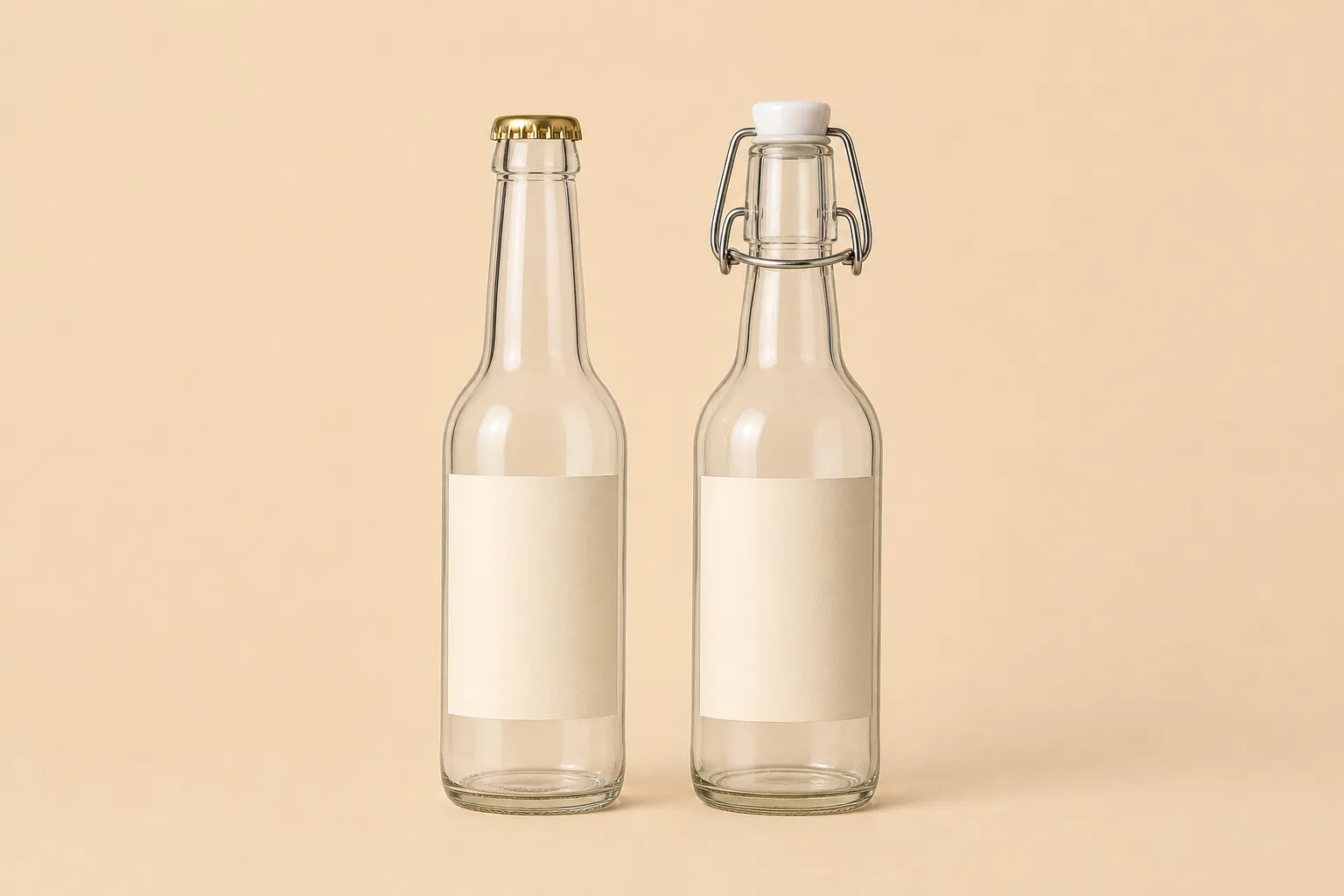
Sixteen further SKUs quote a "screw thread finish (GPI standard)" without a code, five are wide-mouth, seven are cork finish, four swing-top and three crown. Those descriptions are not marketing: they are the interface. A crown cap cannot close a screw neck, and a cork cannot seal a swing-top mouth. Changing the finish is a mould change, not a closure change.
Six closure families, counted
By closure description, the 61 SKUs break down as: twist-off and lug metal lids 9; aluminium screw caps 11; cork and stoppers 12; swing-top 5; crown 3; tamper-evident or pourer 4; wooden lids 3; plastic screw caps 4; and 10 that name a generic screw, metal or plastic cap.
The counts matter because they show where tooling already exists. A family with eleven SKUs has caps, gaskets and decoration options in stock; a one-off closure is a sampling project. Stock depth is the cheapest form of flexibility a buyer can get before committing to a mould.
What each family is for
Jam and preserve formats take twist-off and lug lids — nine SKUs — because a wide mouth needs a lid that opens with wet hands and reseals after a spoon goes in. Three jam SKUs use wooden lids or dippers, which trade seal performance for shelf character.
Oil takes the pourer family: four SKUs specify a tamper-evident cap with a spout, and the rest sit on screw caps. The pourer is part of the closure, so it is chosen with the neck rather than added later.
Wine is the most standardised group: all eight SKUs list cork, screw cap or synthetic cork, and seven of the eight name cork specifically. Beer is equally strict in the other direction: all seven SKUs are crown or swing-top, including flip-top swing caps with a gasket.
Spirit splits three ways: cork and stoppers on four, aluminium caps on three, plastic or wooden closures on two, plus a crystal stopper option. Beverage is the mixed shelf: aluminium, twist-off, plastic and one swing-top across eleven SKUs.
MOQ, lead time and what the closure changes
At GlassPacker, every one of the 61 stock SKUs quotes an MOQ of 1,000 pcs per size — the closure family does not move that number, as the MOQ guide sets out. Lead time is nearly as flat: 54 of 61 run in the 5–7 day band, and the seven longer quotes come from colour and finishing steps rather than from the cap.
What the closure does change is tooling and testing. A stock closure on a stock finish is a catalogue item; a new closure shape, a new finish or a coloured cap becomes a tooling line in the quote. The stock mould economics explain why: body and finish share one mould, so the neck is already paid for.
That is also why the finish list is short. Six coded GPI finishes plus five wide-mouth, seven cork, four swing-top and three crown covers 61 SKUs — a deliberate restriction that keeps caps, gaskets and filling heads interchangeable across the range.
How to specify a closure in one message
Five checks cover most of it. First, the product: carbonated drinks need crown or swing-top, while still liquids and spoonables can take screw or lug. Second, the fill line: a pourer spout changes the fill head and the capping head. Third, shelf life and light: amber glass plus a tight metal lid is the light-sensitive route. Fourth, the opening experience: lug lids crack open and reseal, swing-tops are reusable. Fifth, decoration: a cap is a printable surface, and a coloured cap is a separate line in the quote.
Send those five plus the target capacity. If the neck finish is already on the stock list, the answer is a catalogue SKU with a known MOQ; if it is not, the answer is a mould quote. Either way the finish code is what the supplier needs first, because it decides which closures are even possible.

Quick answers
Can I use any cap on any jar?
No. A closure only fits its own finish. A 63-400 lid will not seal a 70-400 neck, and a crown cap needs a crown finish. Swapping within a family is routine; changing the finish means a new mould.
Which closure should a beer bottle use?
Crown or swing-top. All seven beer SKUs in the stock list are one of the two, including flip-top swing caps with a gasket.
Does the closure change the MOQ?
Not on stock. All 61 SKUs quote 1,000 pcs per size whatever the closure. A new closure shape, a new finish or a custom colour is quoted separately.
Send the product, the target capacity and the closure you have in mind to the inquiry form; GlassPacker answers with the finish code, the closure family and the MOQ in one round — 61 stock SKUs, 1,000 pcs per size, 54 of 61 in the 5–7 day band.
Leave a comment
No comments yet — be the first to share your thoughts.