Stock Mold Glass Jars: Mold Fee & MOQ (2026)

A stock mold is a glass container shape the factory already owns and runs. The tooling exists, the neck finish is proven on thousands of production runs, and any buyer can order the shape without paying a mold fee. For food, beverage, oil and wine brands it is the fastest route from specification to filled product — and the line item most often misread in a quotation.
At GlassPacker, 55 stock-mold designs are live across six categories today — food jars, beverage, spirit, oil, wine and beer bottles, from 100 ml mini jars to 1 L formats. Forty-eight of those 55 ship in 5–7 days at an MOQ of 1,000 pcs per size; the full shape list is in the stock catalog.
What a stock mold is — and what it is not
A stock mold is not a second-quality mold. It is the same tooling system — blank mold, blow mold, neck ring, bottom plate — that produced every container of that shape before yours. What changes between orders is the glass colour, the closure and the decoration, not the geometry.
The practical consequence: capacity, wall thickness and neck finish are fixed and known. You are not buying an engineering project; you are booking production time on a proven tool. That is why stock shapes carry the lowest MOQ and the shortest lead time in any glass quotation.
The mold fee: what you pay, and what you own
A private mold is a one-off tooling charge quoted once and owned by the brand; reorders then pay only the per-piece production cost. A stock mold removes that charge from the first order entirely, because the tooling was paid for long ago across the mold’s production history.
The arithmetic is simple and worth doing before you fall in love with a custom silhouette: divide the tooling charge by your first-order quantity. The same charge spread over 1,000 pcs costs twenty times more per piece than spread over 20,000 pcs, and that per-piece gap never disappears — it only shrinks with volume.
There is also a timing cost. Supplier cost guides published in 2026 place private bottle tooling in the low thousands of US dollars, while the US producer price index for glass container manufacturing moved from 283.3 in January 2024 to 307.7 in August 2026 — a rise of 8.6% (BLS series PCU327213327213P). Quotations age; a stock mold order avoids both the tooling queue and the price drift that comes with re-quoting a new shape.
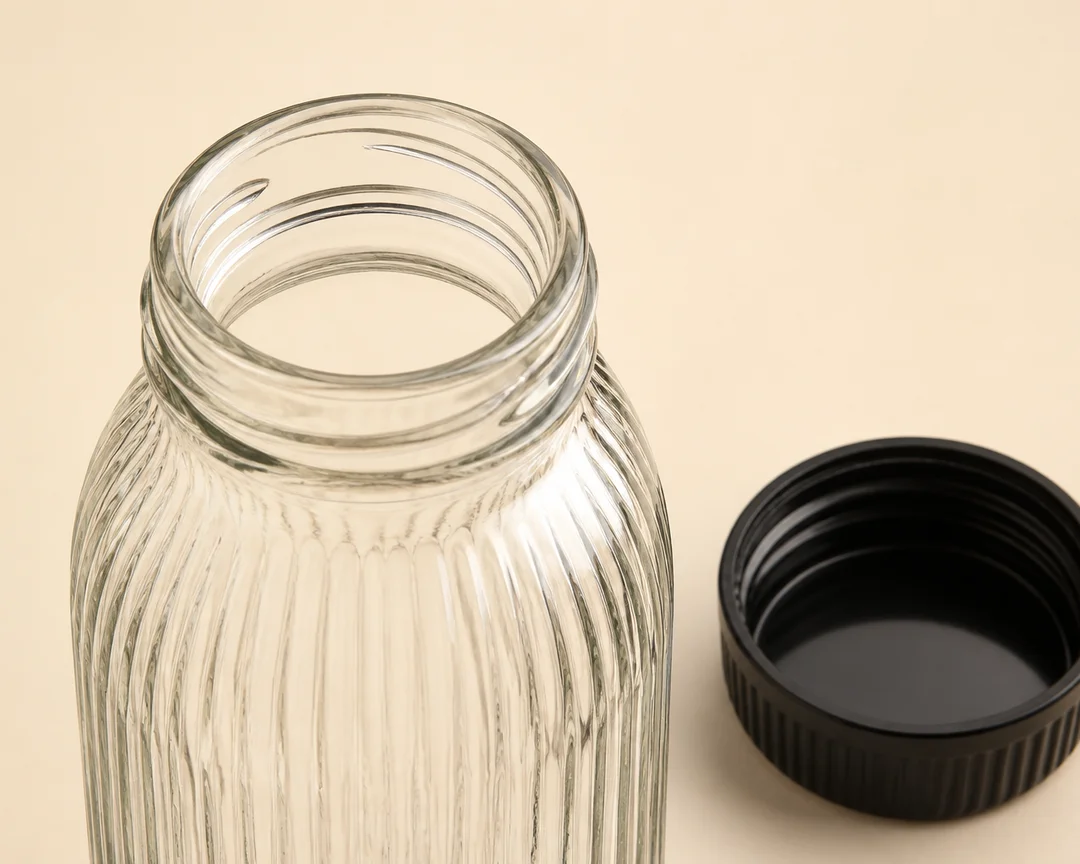
MOQ and lead time on a stock mold
Two numbers decide most launch calendars. At GlassPacker the MOQ on every stock design is 1,000 pcs per size, and 48 of the 55 catalog designs ship in 5–7 days. The seven longer runs — 25 to 40 days — are decorated or custom-colour orders, not stock-shape orders: decoration and colour matching, not the mold, set their schedule.
Sampling sits ahead of both: 7–10 days for a stock shape, longer when a new mold is involved. A production sample confirms capacity, finish and colour before the full run commits — always on the actual shape, because glass curvature distorts printed decoration.
Add freight and the calendar stays honest: sea transport from China to the US or EU adds roughly 25–35 days on top of production. A stock mold order placed today reaches a European shelf in about three months; a new-mold project puts the tooling window in front of that.
What you can still customize on a stock body
Stock does not mean anonymous. Closures and cap colours (black, gold, red, silver), paper and hot-foil labels, screen printing, hot stamping and frosted finishes are all applied after forming, with no tooling involved. Many stock shapes already carry embossed or debossed panels, and adding your own logo as a mold insert is a small one-time tooling step that stays brand-owned.
The one customization that does change the mold is structural: a new silhouette, a proprietary shoulder, or an embossed wordmark in the glass itself. Everything above the shoulder line — closure, colour treatment, label, print — is a stock-body decision.

When a new mold is worth it
Three triggers justify tooling: a geometry no stock shape approximates, an annual volume that amortizes the charge to a rounding error, or a filling line that demands a neck finish outside the standard set. The catalog already covers six GPI neck finishes — 28-410, 31.5-460, 38-400, 63-400, 70-400 and 89-400 — plus crown, swing-top and cork finishes, so “outside the standard set” is rarer than buyers expect.
If none of the three applies, the stock path is not a compromise; it is the cheaper engineering decision. Differentiate at the closure, the label and the carton — the three surfaces shoppers actually touch.
How to write a stock-mold RFQ that gets quoted in one round
Six fields remove every round-trip: target capacity and fill weight, the GPI neck finish (or the closure you already use), glass colour, quantity per size, decoration method, and destination with the Incoterms you want quoted. The MOQ and lead-time guide covers the same four numbers from the supplier side.
Send those six fields to the inquiry form and GlassPacker returns MOQ, lead time, packing — export cartons of 12 to 96 pcs depending on capacity — and HS 7010 documentation in one reply, with samples in 7–10 days.
Quick answers
Is there a mold fee on stock mold glass jars?
No. Stock shapes carry no tooling line in the quotation; you pay per-piece production, decoration and packing. A private mold adds a one-off charge — brand-owned and reusable for the life of the product — plus its tooling window before the first production run.
Can I put my logo on a stock mold jar?
Yes, without touching the mold: screen printing, hot stamping, hot-foil or paper labels and cap-colour matching all sit on the stock body. An embossed logo in the glass needs a mold insert — a small one-time tooling step that remains your asset.
How are stock-mold jars packed against breakage?
In export cartons of 12 to 96 pieces per carton depending on capacity, with inner dividers that keep the finish intact, then palletised and shrink-wrapped. Every quotation lists gross weight, carton dimensions and pallet count per size, so your forwarder can price the container before you commit.
Stock molds exist so that a good idea does not wait for tooling. Define the six fields above, sample the shape, and let the first production run prove the market — the mold decision can follow the sales data instead of preceding it.
Leave a comment
No comments yet — be the first to share your thoughts.