500 ml Glass Jars in 2026: Shapes and Closures
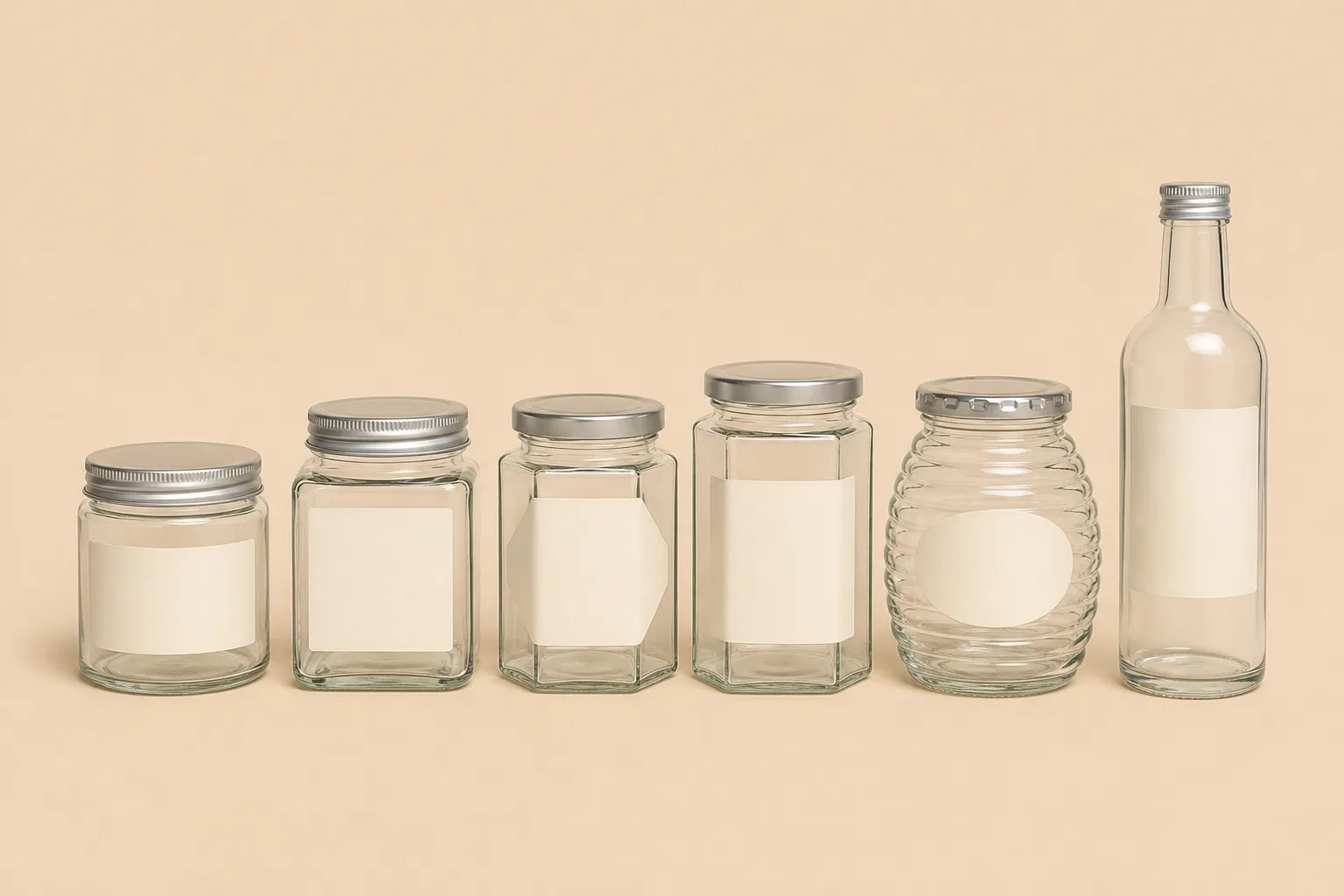
Five hundred millilitres is the most common capacity in the GlassPacker stock list: 29 of 60 jars and bottles hold 500 ml, spread across jam, oil, spirit, beverage, beer and wine. That makes it the capacity most buyers start from — and the one where the number hides the most variation. Volume is the only thing 500 ml fixes. Shape, neck finish, closure family, glass colour, carton count and lead time all move independently of it. This 2026 guide uses the stock catalog as its dataset: what stays constant across the 29, what changes, and which differences actually matter at the filling line.
What 500 ml fixes, and what it does not
500 ml is a fill capacity, not a net weight. Weight depends on what goes in: honey is roughly 1.4 times as dense as water, and the catalog lists a 500 ml honey jar at 700 g, while a 500 ml water, vinegar or brine line lands near 500 g. In US fluid ounces, 500 ml is about 16.9 fl oz — the number a US buyer brief usually starts from.
What the capacity does not fix is everything a buyer sees and fills: the body (round, square, hexagonal, octagonal, ribbed, flask), the neck finish (wide-mouth, screw thread, crown, swing-top, cork), the closure, the glass (high-white, soda-lime, amber, crystal, borosilicate, lead-free) and the cartons per case. Two 500 ml jars can differ in all of them.
Across the 29, one number is constant: every 500 ml SKU carries an MOQ of 1,000 pcs per size — per size, not per order. Lead time is close to constant as well: 27 of the 29 sit in the 5–7 day stock band. The MOQ guide explains why the minimum is set per size; the short version is that each size is a separate mould slot.
Six body families at 500 ml
The stock list covers round cylindrical bodies for spirit and oil, square storage jars, hexagonal six-facet honey jars, eight-facet tall octagon jars, beehive-ribbed honey jars, and flat rectangular flask or bulbous teardrop bottles for fruit wine.
Shape is not cosmetic at this capacity. A square or hexagonal body uses shelf width differently from a round one and gives the label a flat panel to sit on; a ribbed or faceted body adds reflection but complicates label adhesion and print registration; a flask body reads as premium spirit while holding exactly the same 500 ml.
Shape also decides which closure family is available, because the finish is cut into the same mould. Body and closure are one decision, not two — the stock mould economics are the reason a stock body keeps both cheap.
Closures at 500 ml: five families
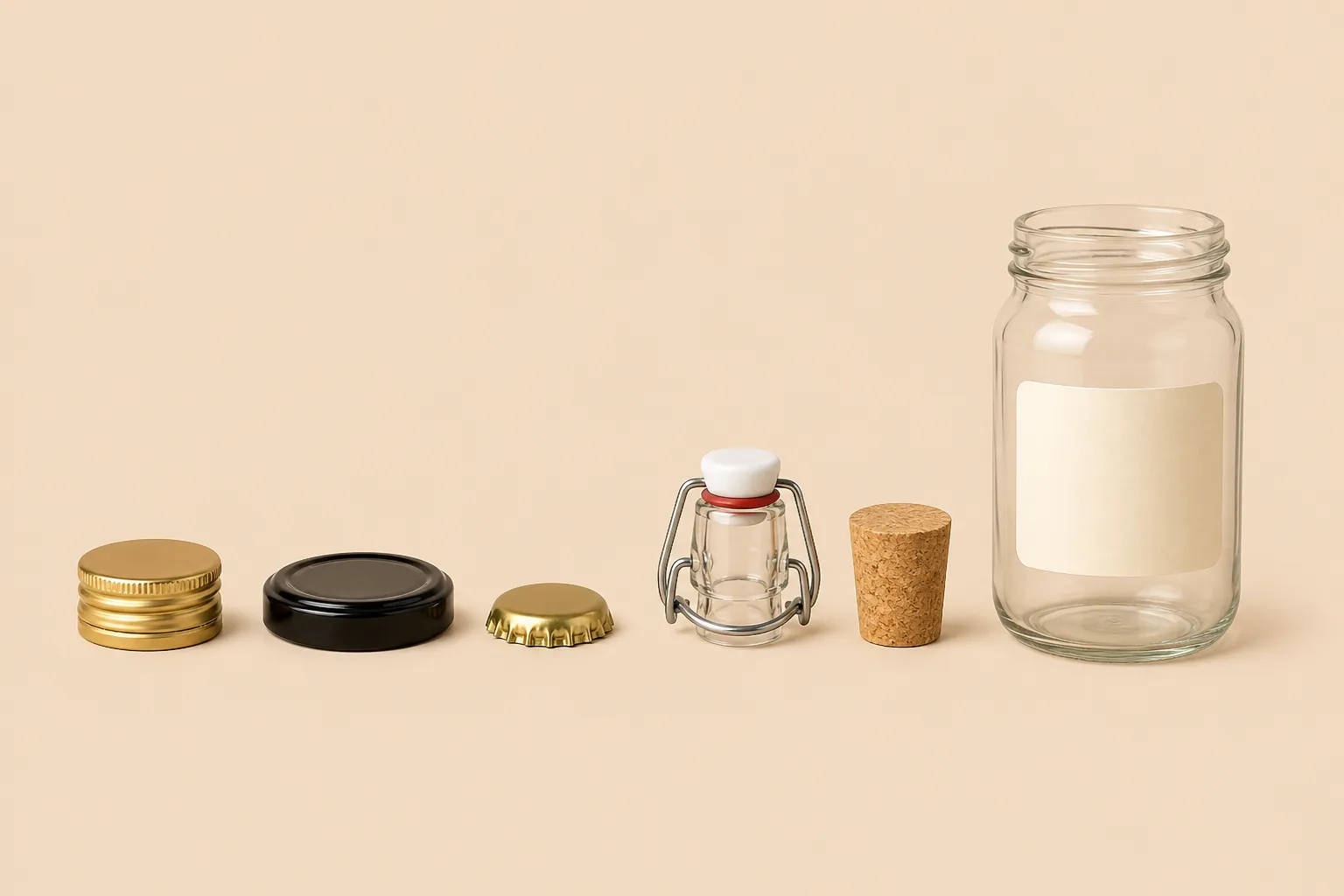
Wide-mouth twist-off metal lids cover the spoonable end: pickle jars, condiment jars, hexagonal and square storage jars. The lid diameter matches the wide mouth, and the closure is specified with the jar rather than bought separately.
Aluminium screw caps cover honey jars and spirit bottles — gold, silver, black or red, smooth or ribbed. On honey the cap is part of the shelf design; on spirits it carries the tamper and tax-stamp surface.
Tamper-evident caps with pourer spouts cover oil and juice bottles: the pourer is part of the closure, so it is chosen at the same time as the neck finish.
Crown caps and swing-tops cover 500 ml beer bottles, including flip-top swing caps with a gasket. The swing-top body is resealable, so the same shape serves returnable and gift formats.
Cork and glass stoppers cover wine-neck bottles, including a crystal stopper on a 500 ml spirit bottle.
The engineering rule behind all five: a closure only fits its own finish. GPI codes make that explicit — the 500 ml amber oil bottle uses GPI 28-410 — while wide-mouth jars use a wide-mouth finish and beer bottles use crown or swing-top necks. Swapping closures inside a finish family is routine; changing the finish means changing the mould.
MOQ, lead time and carton counts
At GlassPacker, MOQ is 1,000 pcs per size on all 29 SKUs. That is the stock floor, not a negotiated number: it comes from the mould slot and the carton run, and it does not change because a 500 ml jar is small.
Lead time splits 27 to 2. Twenty-seven 500 ml SKUs are quoted in the 5–7 day stock band; two carry longer quotes — a 500 ml amber oil bottle at 28–38 days and a 500 ml square honey jar at 25–35 days — and both show what a colour or finishing step adds to a plain stock run. The lead-time guide lays out the four bands; here the practical reading is that colour, not capacity, moves the date.
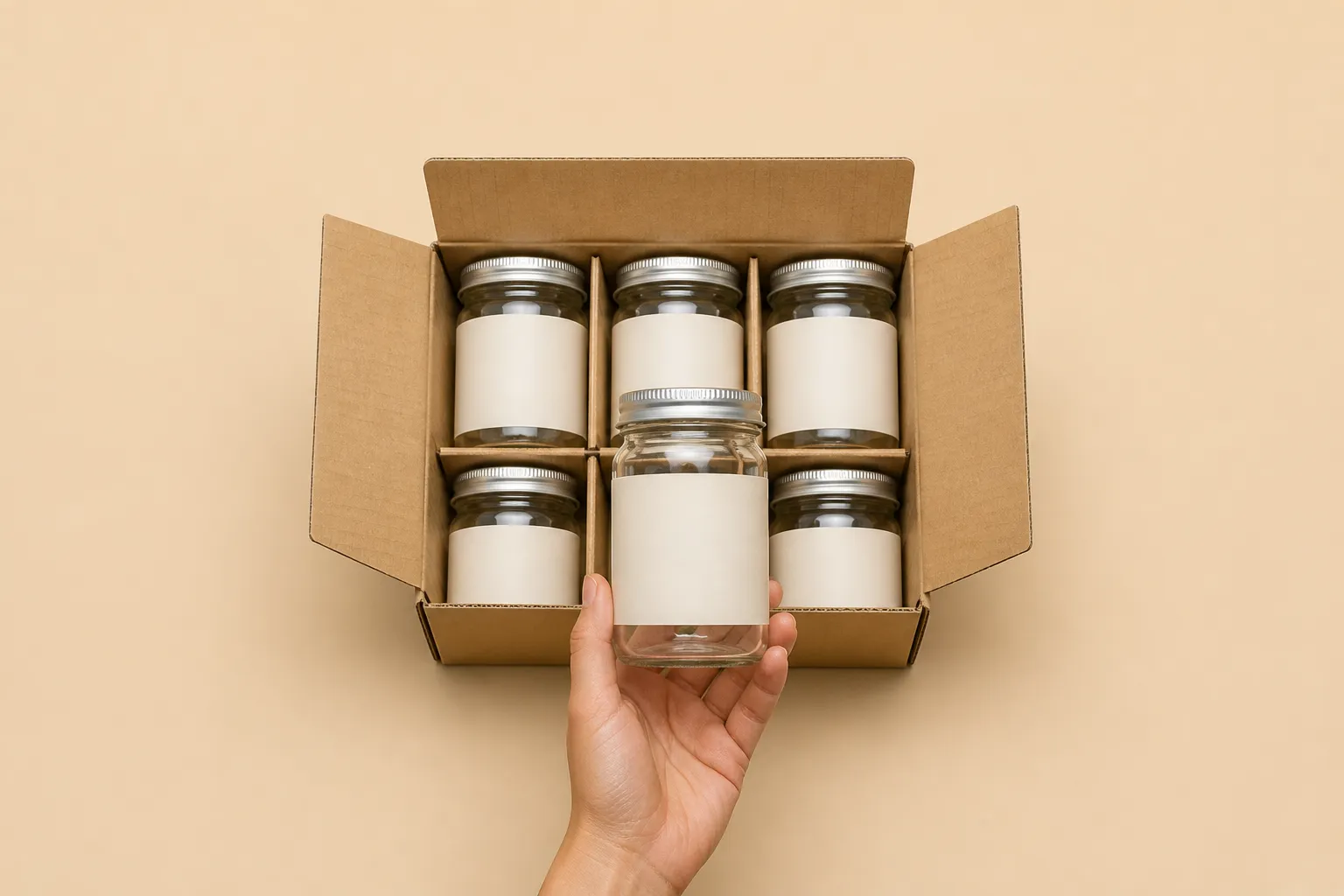
Carton counts are quoted per SKU, because they depend on dividers and the pallet plan. Where the stock list publishes a count for a 500 ml jar it runs 24, 48 or 70 pcs per carton — a nearly three-fold spread that changes freight per piece far more than the glass price does. Ask for pcs/ctn and carton dimensions with the quote.
The glass itself is mostly high-white: 12 of the 29 are listed as high-white glass, 7 as soda-lime and 4 as high-white soda-lime, with 2 in high-white lead-free, and amber, crystal, borosilicate and clear lead-free each on a single SKU. Colour and material are also lead-time variables — the amber 500 ml oil bottle is one of the two longer quotes.
How to choose a 500 ml jar in five checks
First, convert volume to net weight: density decides whether 500 ml is 500 g or 700 g, and the label has to state the legal net weight. Second, choose the closure by product behaviour — twist-off for spoonable, screw cap for liquid, crown or swing-top for carbonated, cork for wine. Third, choose the shape by shelf and label: square and hexagon bodies pack tighter and print flatter; round bodies read classic. Fourth, test decoration on the actual body, because curvature and facets distort print in ways a flat proof cannot show. Fifth, get pcs/ctn and the pallet plan before comparing landed cost.
None of the five needs a custom mould. Every one is a choice between stock 500 ml SKUs that already share the same MOQ and, for 27 of 29, the same 5–7 day band.
Quick answers
Is a 500 ml jar the same as a 500 g jar?
No. 500 ml is volume and 500 g is weight. Water-based products land near 500 g, while honey — about 1.4 times as dense — fills a 500 ml jar at roughly 700 g, which is exactly how the catalog lists its 500 ml honey jar.
Do all 500 ml stock jars share the same MOQ?
Yes: 1,000 pcs per size on all 29 stock 500 ml SKUs. A new mould, a custom colour or a decoration run is quoted separately, because those steps sit outside the stock slot.
Can I change the closure on a stock 500 ml jar?
Within the same finish, yes — a plain or printed twist-off lid, a gold or silver aluminium cap. Changing the finish itself, for example from a wide mouth to a GPI 28-410 neck, means a new mould rather than a new closure.
Send the product, target fill weight, closure preference and destination to the inquiry form and GlassPacker answers MOQ, lead time and carton count in one round: 1,000 pcs per size, 5–7 days on 27 of the 29 stock 500 ml shapes.
Leave a comment
No comments yet — be the first to share your thoughts.